
The hour on the calendar isn’t the cost. The cost is what happens next: someone sits down with half a page of notes and tries to reconstruct an hour of conversation into something the rest of the team can act on.
That reconstruction is where the money leaks. Not because anyone’s careless. Because human memory is doing a job it was never good at, an hour after it stopped paying full attention in order to write things down.
We fixed it with a $189 device and a prompt.
Disclosure: the product link below is a paid link. Sumner Digital is an Amazon Associate and we earn from qualifying purchases at no additional cost to you.
The workflow
The device is a Plaud Note Pro. It sits on the table, records the conversation, tells the speakers apart, and lets us put real names on them. That last part matters more than it sounds, and we’ll come back to it.
The companion desktop app covers the other half of the week. It runs on Mac or Windows, detects Zoom, Teams, Meet, Slack huddles, Webex, and Lark, and captures the call without a bot joining and announcing itself. So the client call and the client meeting land in the same library rather than two systems that don’t know about each other. It’s in beta, and it requires a Plaud device bound to your account plus an active membership, which is worth knowing before you read “free desktop app” anywhere else.
What comes out is two things: a summary, and a full transcript.
The summary is good. It’s also generic, because it doesn’t know our clients, our terminology, or the format our team actually reads. So we don’t use it as the deliverable.
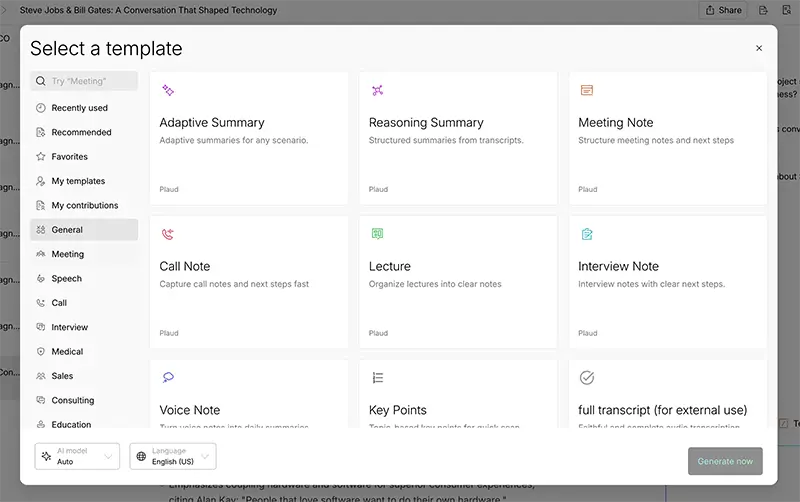
The transcript is the deliverable’s raw material. We hand it to Claude along with our actual client-meeting-note template, and get back notes in our structure, in our language, in the shape the account file expects. Ten seconds instead of forty minutes, and it doesn’t degrade at 4:45 on a Friday the way a human summarizer does.
Why naming the speakers is the whole trick
An unattributed transcript is a wall of text. A transcript that knows who said what is a record of commitments.
Once speakers are named, our summaries come back with action items attached to the people who took them on. Then you share it with everyone who was in the room, and they pull their own follow-ups.
This quietly kills the most common failure in client work: four people leave a meeting with four different understandings of who owns what, and nobody finds out for two weeks. A named, shared, same-day summary from a neutral source collapses that. Nobody argues with the recorder.
One practical note: name the speakers before you generate the summary. A summary that already exists keeps the labels it was created with until you regenerate it.
The two things you need to know before you copy this
Transcription is metered. The device includes 300 free minutes a month. Past that, it’s $99.99 a year for 1,200 minutes a month. Minutes don’t roll over. Five hours goes fast if you let the desktop app record every call automatically, so budget against a normal month, not a light one.
You have to get consent, and in Florida that’s not optional. Florida is an all-party consent state under Statute 934.03, and it covers wire and electronic communications, so calls count. Everyone in a private conversation has to agree before you record. Being in the meeting doesn’t give you the right to record it, and violations are a felony, not a formality. Worth knowing: the reasonable-expectation-of-privacy argument people reach for only applies to in-person conversations. On a call, consent is required outright.
The desktop app raises the stakes rather than lowering them. Record natively in Teams and everyone sees a banner. Plaud Desktop isn’t the platform recording and doesn’t join as a bot, so no notification fires. Nobody knows unless you tell them, which is the convenience and the liability in one sentence. And on a call with people in three states, courts have disagreed about whose law governs, so assume the strictest one applies.
One sentence at the top of the meeting solves all of it. Say the sentence every time, check your own state’s law, and ask your attorney rather than a marketing blog.
The actual point
The device isn’t the interesting part. The interesting part is that a meeting transcript is structured input, and structured input is what AI is genuinely good at.
Most teams are using AI to write things. The better use is to stop re-deriving things you already have on record.
The device we use. (paid link)
As an Amazon Associate, we earn from qualifying purchases.